


Overnight train travel is enjoying a renaissance. In the second half of last year and in early 2026, a host of exciting new rail routes have been launched — stretching from the Alps through the Carpathian Basin to the Baltic and Adriatic coasts — breathing fresh life into sleeper-car travel across Europe. As climate awareness grows and travellers increasingly seek alternatives to flying, sleeper trains are experiencing a revival, offering countless possibilities for the perfect extended weekend away. We’ve rounded up the most intriguing new routes to watch.
1. Carpathia EuroNight: Przemyśl-Budapest-Munich, across five countries
On December 14, 2025, the Polish operator PKP Intercity launched the Carpathia EuroNight overnight train, which connects southern Poland with Bavaria while crossing the Czech Republic, Slovakia, Hungary, and Austria along the way. The evening departure train runs from Przemyśl through Kraków to Bohumín, where it splits into two sections: one portion continues via Bratislava to Budapest (arriving at 8:29 the next morning), and the other heads through Vienna to Munich, coming later in the morning. In this way, the route strings together the capitals and major cities of five countries in a single night, offering passengers a true Central European tour.
With this service, PKP Intercity is signalling its intention to be a serious player in the European night train market. The company recognised the regional demand for direct connections: the train offers comfortable overnight travel from the southeastern corner of Poland to Western Europe, providing a competitive alternative to long bus rides or flights. Early experience indicates a strong interest – no surprise, since passengers can travel across four countries in one night. The luxurious sleeping compartments, each equipped with a private shower and with breakfast included, also add to the route’s appeal, which is a sign of rail innovation in Poland as well.
2. Baltic Express: Prague-Gdynia, an overnight journey to the Baltic Sea
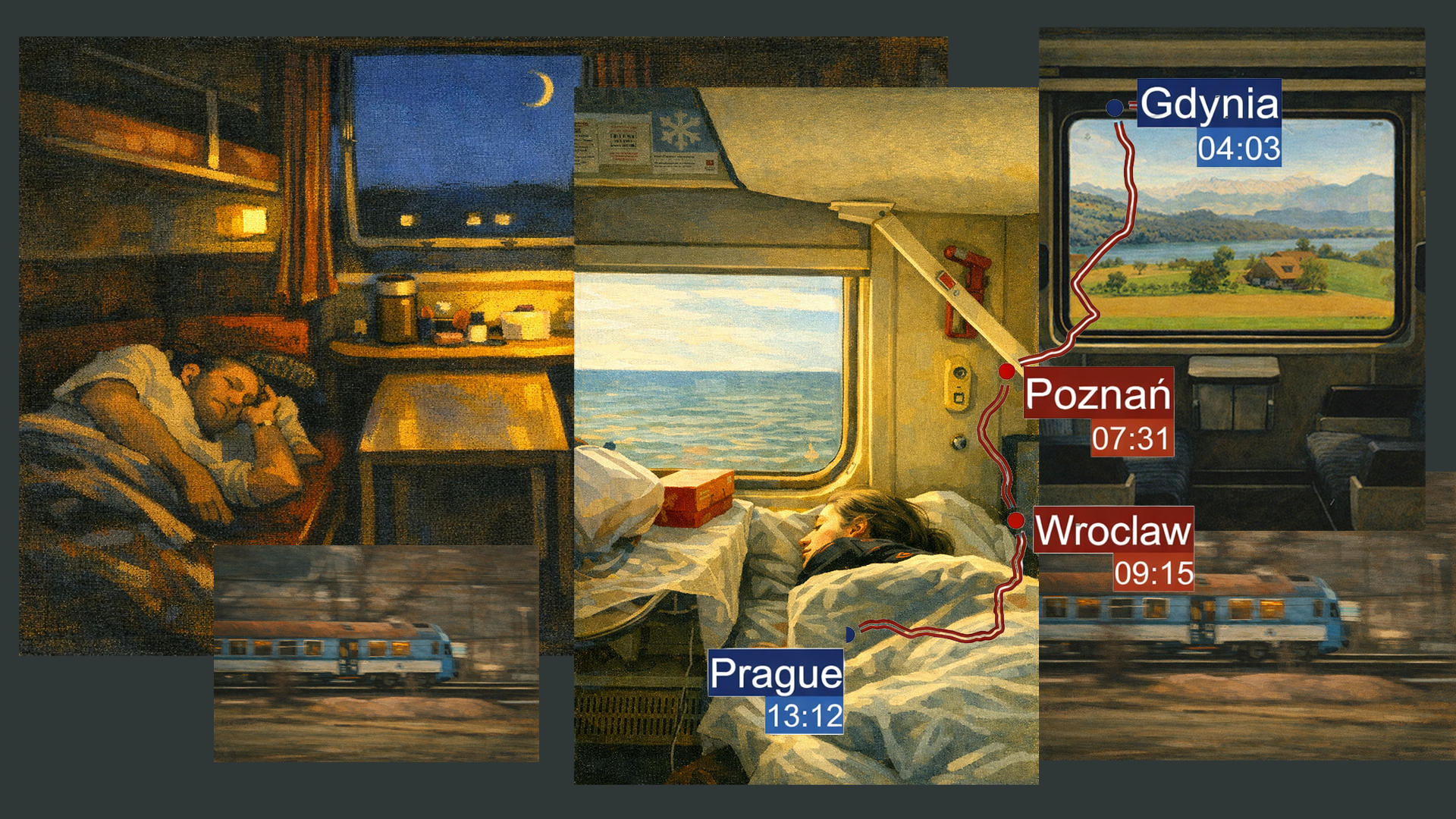
The Baltic Express is another brand-new night service from PKP Intercity, which debuted in the summer of 2025. Departing from Prague, it travels through the night and arrives the next morning in Gdynia, Poland’s Baltic Sea port city. The train operated on a trial basis from April to August, and proved so popular that its run was extended through September. According to several Polish news portals, the Baltic Express will return in 2026; indeed, some sources reported that, as of December 2025, it had become a permanent part of the timetable, potentially making it available every summer season.
The Baltic Express is a model of Polish-Czech cooperation, as it links the northern Czech region with Poland’s coastal region. PKP Intercity, working together with the Czech carrier ČD, aimed this service at seaside vacation travellers. The reception was excellent: the train ran fully booked during the summer months, showing that the public is eager for themed destinations, such as reaching a beach holiday by train. The success demonstrates that, given the right offerings, people are willing to spend even 15-16 hours on a train if it means they can reach their vacation spot comfortably and enjoyably. Plans indicate that from 2026 onward, the Baltic Express could become a permanent part of the summer timetable.
3. Adriatic Express: Warsaw-Rijeka, an overnight train to the coast
The Adriatic Express between Warsaw and Rijeka, Croatia, began a trial run in mid-2025, establishing a direct link between Poland and the Adriatic. Over the roughly 19-hour journey, the train travels through the Czech Republic and Austria (via Vienna) to reach the Croatian coast. Since the service specifically targeted the summer holiday season, in 2025 it operated only in July and August. Success was not lacking here either: due to significant interest, the Warsaw-Rijeka night train will return in summer 2026, expected to run from the end of June through the end of summer. This service is exceptional in that it creates a direct connection between Central Europe and the Adriatic – previously, there had been no night train of such length in the region.
With this train, the Polish railway is capitalising on Polish travellers’ demand for the seaside. A nearly 20-hour trip may seem long at first, but by resting in the train’s comfortable sleeping cars, passengers can wake up the next morning to the sight of the Adriatic Sea. The reception in 2025 was extremely positive – many appreciated that they could reach a seaside vacation spot overnight without any transfers. This service shows that railway companies see potential in the tourist segment as well, beyond the classic business and intercity routes. Thanks to the success of the Adriatic Express, it is increasingly likely that more similar seasonal night trains will launch in Europe specifically for holidaymakers.
4. Nightjet 2.0: Austria’s ÖBB unveils a new generation of sleeper cars
Austria’s state railway, ÖBB, has, in recent years, deliberately been building the backbone of Europe’s night train network. Their Nightjet sleeper trains connect numerous countries, and ÖBB is expanding its offerings with significant investments. They have ordered 33 brand-new Nightjet 2.0 trainsets, worth over 500 million euros, to replace the old coaches over the coming years gradually. The first new Nightjet train entered service at the end of 2023, and from December 2025, passengers on the Zurich-Hamburg route have been able to travel in these ultra-modern carriages. In 2026, the new Nightjet trains will also gradually appear on routes to Vienna and Amsterdam.
The new generation of sleeping cars aims to adapt overnight travel to 21st-century needs. In the design, the primary focus was on increasing comfort and private space. Each sleeping compartment has its own toilet and shower, and the “Comfort Plus” cabins even feature a separate work area and seating area. The real innovation is the “Mini Cabin,” a single-person, capsule-like sleeping compartment that offers affordable private space for solo travellers. In the Mini Cabin, a fold-down breakfast table, reading lamp, mirror, and innovative storage solutions enhance passenger comfort, and, if needed, two units can be connected for couples travelling together. On the technology front, these trains also represent a leap forward: free onboard Wi-Fi is available (with streaming capability on the ÖBB Railnet Night portal), each compartment has USB ports and wireless phone chargers, and special windows boost mobile phone signal reception. The doors can be opened with an NFC card system, and a security camera system monitors passengers on board.
With Nightjet 2.0, ÖBB is clearly striving for a market-leading role in the night train sector. Introducing new coaches not only improves the passenger experience but also makes rail travel more attractive than air travel. As the ÖBB CEO put it: “With the new Nightjets we will offer even more comfort and privacy – thereby signalling our commitment to night train travel.” Other national railways are following the Austrians’ example: the railway companies of France, Germany, Switzerland, Sweden, and Italy are also working in various partnerships to launch new night services. The rollout of ÖBB’s Nightjet 2.0 is a symbolic milestone: it shows that with proper investment and international cooperation, the night train can once again be a competitive, modern way to travel in Europe.
8. “Espresso Monaco”: Rome-Munich, from exceptional service to a permanent link
The Italian operator Trenitalia’s tourism subsidiary, FS Treni Turistici Italiani, has for years been organising occasional night trains for special occasions under the “Espresso” brand. In 2024, for example, they launched an Espresso Riviera service between Rome and Marseille during the summer season. In 2025, they launched two new themed routes: on weekends in September and October, the Espresso Monaco carried revellers from Rome to the Oktoberfest in Munich, and in December, the same train took passengers on two Advent weekends to Munich’s Christmas market. These special trains were wildly successful – many Italian travellers set out for Oktoberfest specifically on this “party train,” which arrived in Bavaria’s capital by morning.
However, the limited-run Espresso Monaco was only the beginning: plans call for the Rome–Munich connection to become permanent from 2026, and in the most modern form. According to information from the industry journal Railway Pro, Trenitalia, Germany’s Deutsche Bahn, and Austria’s ÖBB have signed an agreement to establish a direct high-speed rail connection between Rome and Munich by the end of 2026. It is expected that Italian Frecciarossa high-speed trains will serve the route, linking the two cities in about 8.5 hours. This will be a daytime service, but it can complement the night offerings – for example, travellers could take an overnight sleeper train on the way there, and then a fast daytime train back the next day.
ÖBB has indicated that the Munich–Rome night train (which currently exists via another route through Salzburg) will definitely be retained in the future as well. The story of Espresso Monaco shows how a successful experimental project can become a permanent service. First, a few special trains tested the waters, and now the three national railways’ cooperation is shaping a more intensive partnership between Germany and Italy. The permanency of the Rome-Munich line will come in handy not only during Oktoberfest: it establishes a year-round direct connection through the Alps between the Italian Peninsula and Bavaria, a development significant for tourism and business alike.