


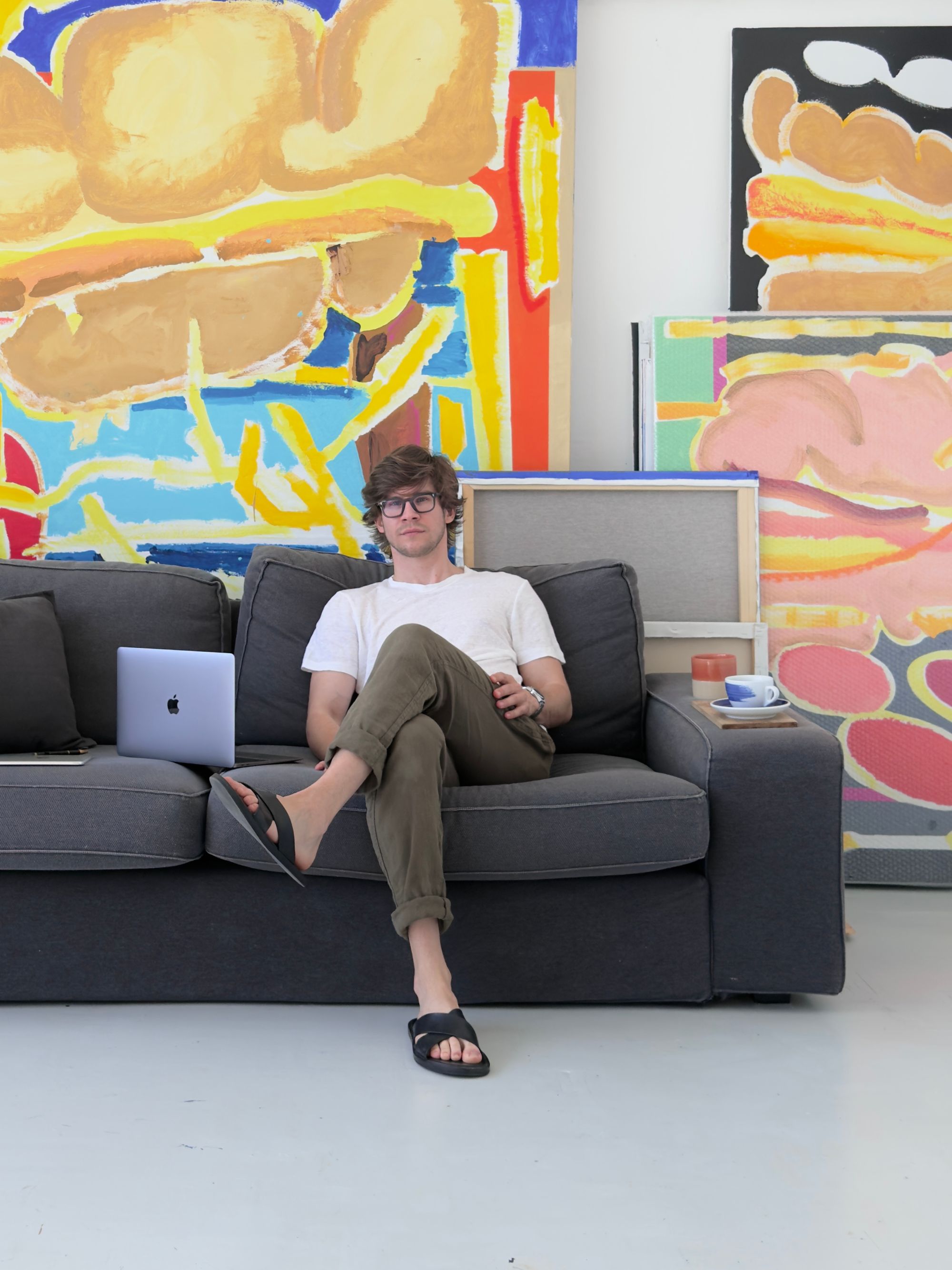
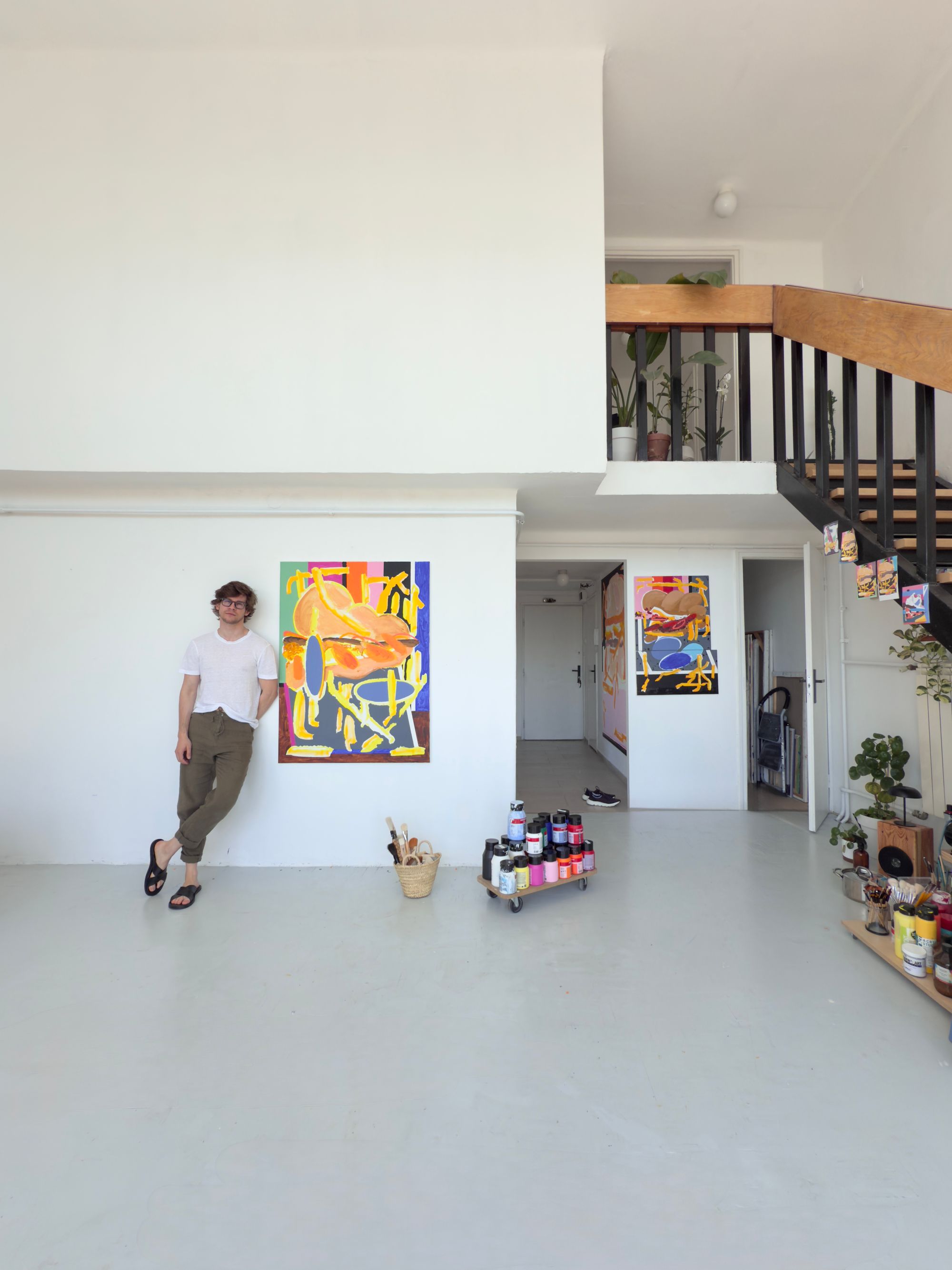
Sneakers, burgers, chips, tubs of sauce – at first glance, all this could be nothing more than a mere list of a mindless (food) consumer’s favorite accessories. Yet when these motifs appear on a vast canvas in bold hues, the image inevitably carries a dual meaning: does the painter live the same lifestyle as I do, or – on the contrary – is he holding up a mirror to our materialistic, mechanical, everyday existence? With his vivid works, Ádám Dóra brings us closer to the iconic, instantly recognizable elements of Western societies, reimagined as colorful, abstracted images – to us, the very people who consume them.
September 2016, the Art Market Budapest, a traditional professional showcase. In the upstairs section reserved for universities, you greeted me with a bright, enthusiastic smile at your tiny booth – inviting me closer, sharing information, telling stories. I still have the business card you handed me then. Many circumstances have changed since, yet your determination and persistence seem to have remained intact. How do you see the time that has passed?
It really touches me that this scene has stayed with you. Indeed, many circumstances have changed – that’s a fact – but what hasn’t is that I’m still dedicated to painting. I think in terms of a body of work, and I consciously strive to build this up with interrelated pieces and series.
Looking back – both in terms of visual elements and content – I have constantly undergone transformations and continue to do so, but I think that is natural within an artistic practice. If I think more deeply, perhaps my trajectory is most clearly evident in the increasingly reduced, distilled visual solutions. At least that’s how it feels to me inside.
How do you relate to your earlier works? How do you view your past phases or periods today?
There are surprises, both positive and negative. The beauty of it is that one constantly changes, reevaluates concepts, and personal taste itself is something fluid and shifting. If I just think about my favorite foods, or the clothes in which I feel comfortable, I see how different that was three to five years ago. The same applies to my relationship to paintings – at least on a sensory level.
I was fortunate to see one of my 2019 works, held in the collection of the Hungarian National Bank, again after several years at the Ludwig Museum, in the exhibition Y-profile curated by Gábor Rieder. It was an especially refreshing experience to encounter my painting in a spacious setting, under different light conditions, one I had originally painted years earlier in my small Buda studio right after university.
Of course, there are also occasions when older works resurface from storage, and I feel that I can no longer connect to them in that form – they are closed chapters, events of the past…
But the perspectives of audiences, collectors, and institutions approach a work not from my own personal taste or emotional state, which allows for a much more objective kind of feedback.
Do you ever return to a painting, perhaps repaint it, because somehow your present self still feels addressed by it?
The redefinition of motifs is something that constantly surfaces; the reason lies in that inner core, the point of origin that drives my entire painting practice. “The core of the onion” – to use that very apt English phrase.
Gestures, one’s personal relationship to colors and forms, cannot be erased from an autonomous artistic activity. The question is rather what one wishes to express through them, where one’s interests or field of research – however we name it – currently lie. Repainting was once an obsession of mine, but at the time I worked exclusively with oil paint, building thick impasto layers upon one another, which enriched the structure of the image. In my current works, the translucency of the white homogeneous ground and its integration into the composition rarely, if ever, allows for that.
You once mentioned you don’t like to overthink your paintings – but at the same time, how much do you care about what they trigger in others? About the feedback you receive?
Put differently: do you read comments?
Overthinking, as I see it, can lead into a constant maze, a dead end that may ultimately sabotage the work, the development, and the results. That is the lesson I drew from my university years and those that followed.
That said, I believe an artist must possess a complex way of thinking and expression, must understand what they are doing, what they are reflecting on, and what this may provoke in the audience. A work, a series, an exhibition, an entire period – in other words, an oeuvre – is built through conscious gestures and decisions.
And it is only natural that each viewer will have their own path opened by a work of art. I do welcome professional critiques and feedback, and I strive to grow through them – provided they are constructive in intent. As for destructive commentary, I keep my distance from it in every area of life.
At a recent guided tour, András Réz, albeit benevolently, referred to you as a “still life painter.” What did you make of that?
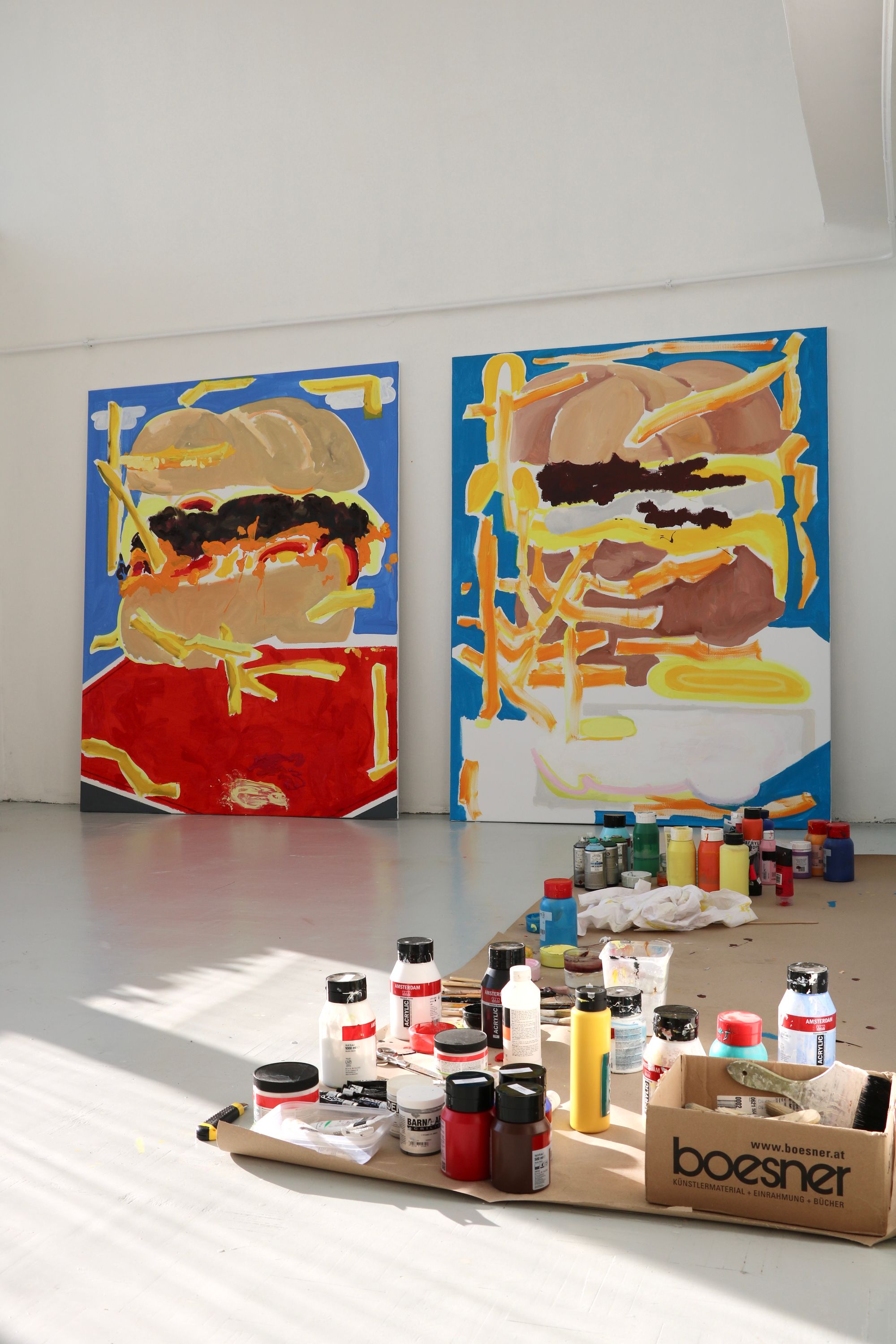
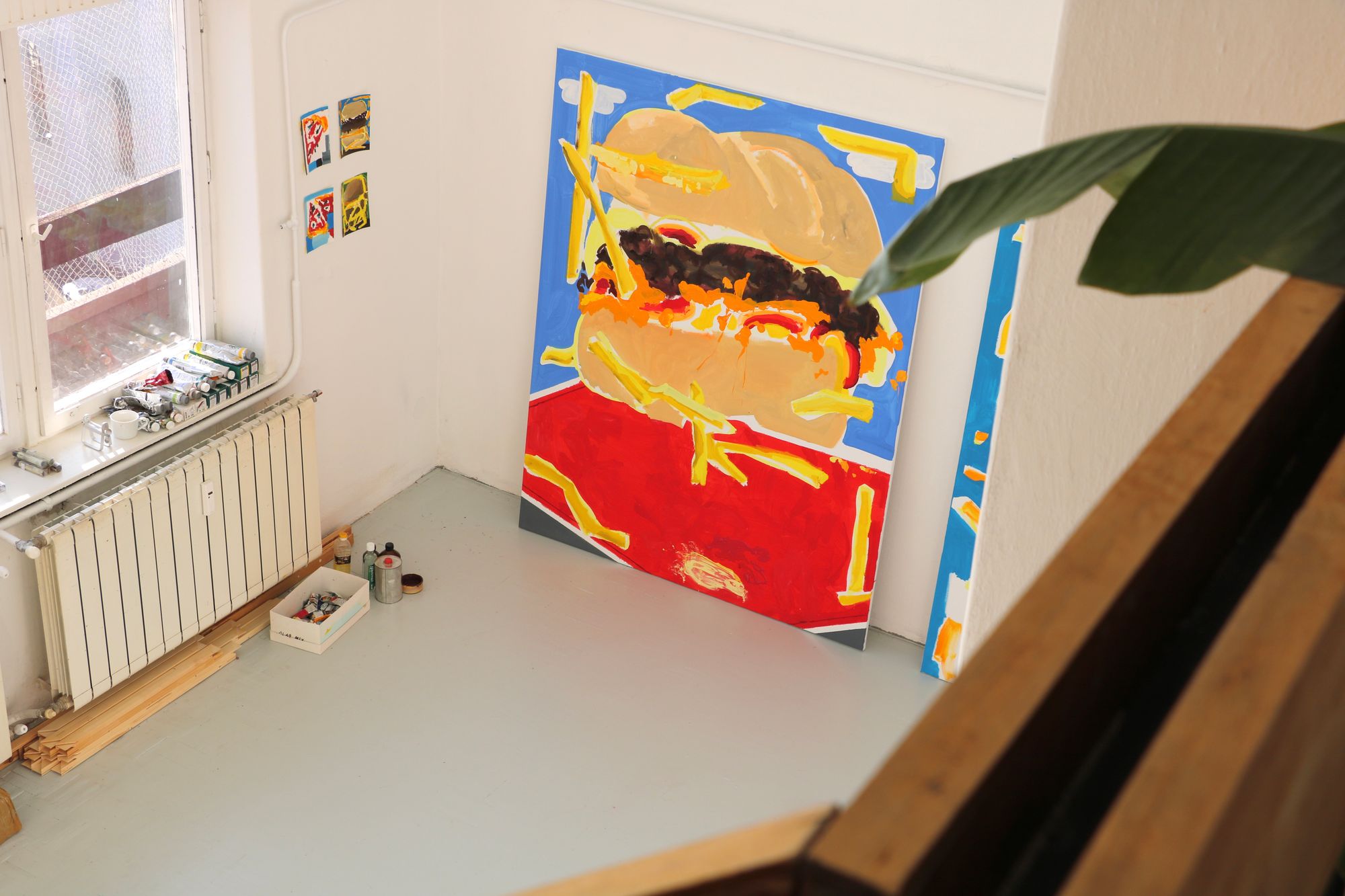
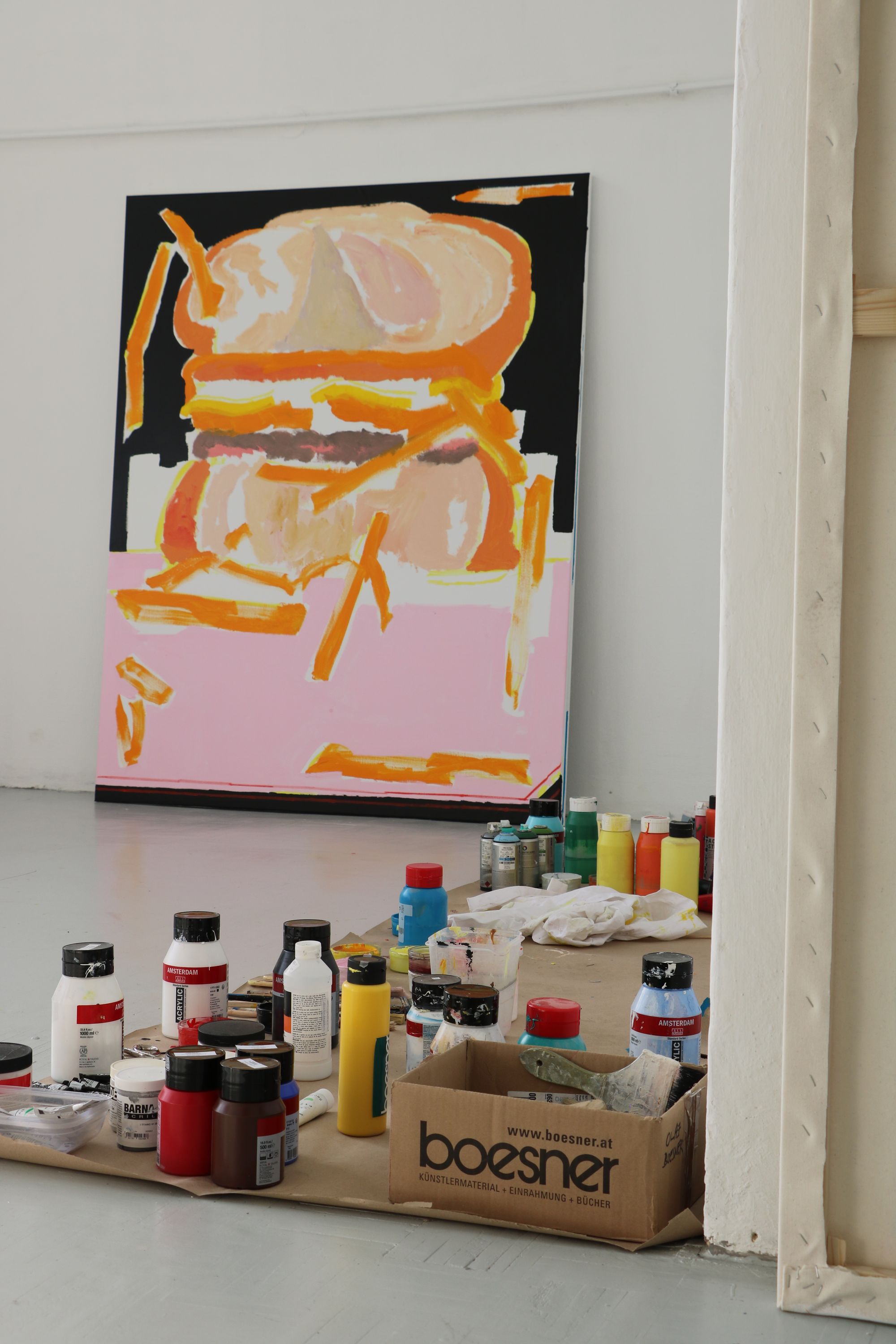
I actually liked it a lot, because that particular exhibition – Fast Lane to Happiness – really did present still lifes, and I’ve always been drawn to them. I’m fascinated by the depiction and accumulation of objects on canvas, and by the effect produced when a traditional pictorial medium renders contemporary consumerist motifs – magnified, decontextualized, painted with loose, sometimes exaggerated yet sensual gestures. Hamburgers, pizza slices, fries, sneakers, or tubs of sauce.
In your work you combine pop-cultural icons with experience-based layering – how do you begin a painting so that it doesn’t slip into design exhibition territory, and remains distinctively yours, even “pop” in tone?
The answer is simple: I try to paint images, not design objects. And I can say it doesn’t come particularly hard to me, since the former – including my student years – I’ve been engaged in for almost two decades, while the latter I only admire from the outside.
I’ve noticed increasingly often that the boundaries between art and design are blurring, and the old clichés – that painting is only oil on canvas, or that design objects and artworks are completely separate – are gradually disappearing.
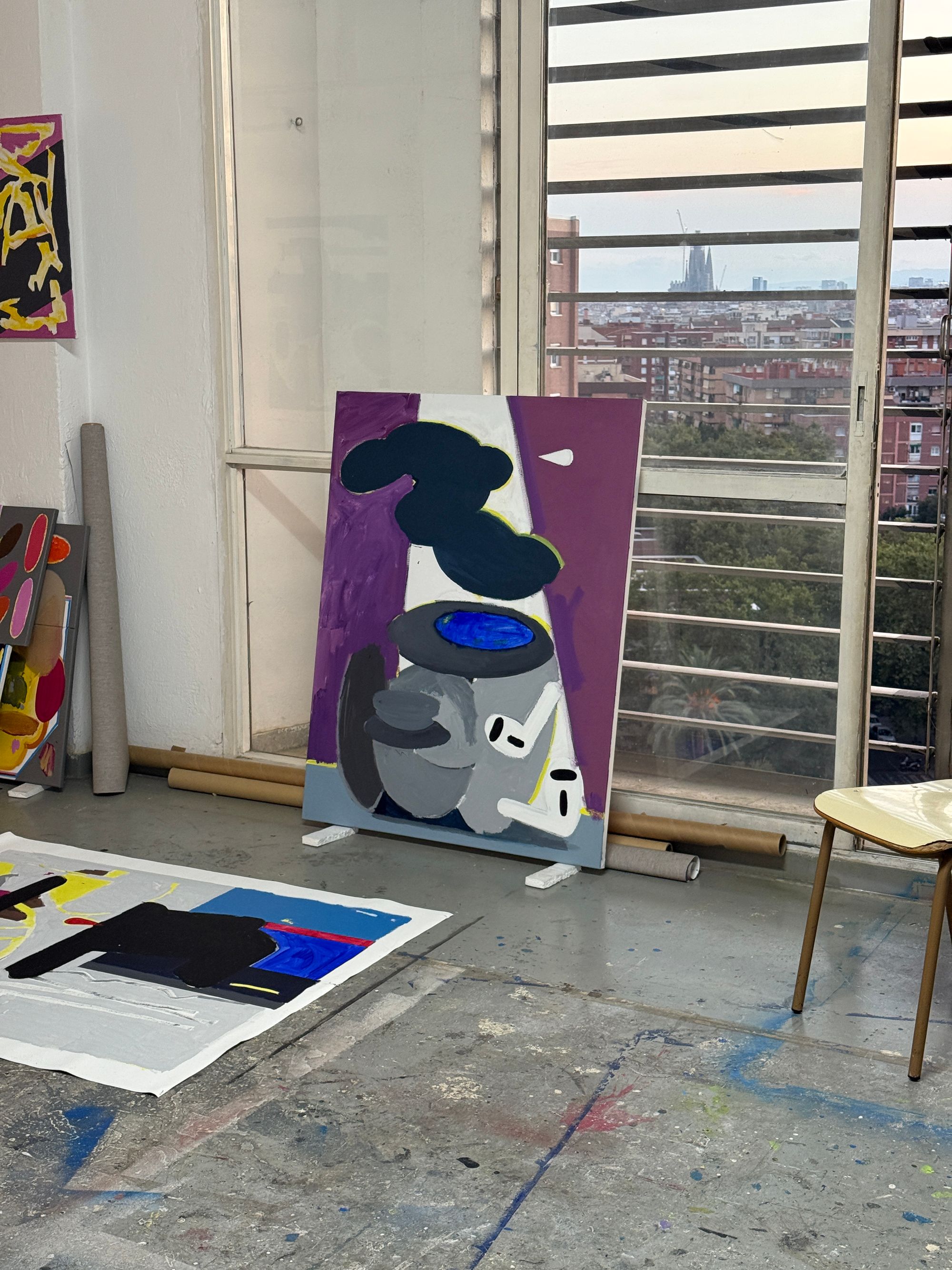
Just a few weeks ago, for instance, at Side Gallery in Barcelona, I had the privilege of a fantastic private tour. Surrounded by objects with concrete functions within an interior, I constantly had the feeling they could just as well stand as artworks, because they possessed such aura, intellectual depth, and sensuousness.
Have you considered expanding your medium? Are you drawn to new techniques or practices that might push you beyond your current framework?
This idea is always hovering in front of me, and the visions are becoming more and more concrete – but I haven’t yet found the right technique.
It would definitely require a spatial medium, but I want to work with durable materials.
You’re known for a consistent social presence – one often runs into you, you seem lively, curious. Do you also follow the younger generation? Do you have connections with painters still in training?
It’s not intentional, even if it seems that way. By nature I’m curious: what interests me, I pursue, I make connections – but just as much, I ignore what doesn’t excite me, or what I can’t resonate with.
There are a few younger artists I follow, whom I find interesting and promising. I’m curious to see what direction the generation after us will steer the visual arts.
Beyond your painter’s side – what recharges you, what helps to rewire your mind? Where do you turn when things feel heavy or empty? For example, what are you reading right now?
Sports and cooking – for me these are the perfect ways to relax from work, so they’re daily activities. Beyond that, in summer it’s the sea, in winter the Turkish bath and sauna. All of these, whether alone or with company, offer great recreation.
Among my friends I count several sculptors and intermedia artists, so it’s always exciting to glimpse their work too, and to encounter other modes of expression and perspectives, which we often discuss together.
When not reading professional texts, I mostly turn to poetry for refreshment. I like leafing through Pilinszky and Weöres. For some time now, one of my favorites has been Léleküdítő (Soul-Refreshing), edited by Dr. Ödön Wildner – a collection of varied quotations and reflections. Sometimes it makes me ponder, sometimes I just laugh out loud and carry on with my day when I open it.
What do you look for when you consume art?
I couldn’t name a single thing – the enjoyment of art can branch into many directions, just as art itself does. For example, I expect something entirely different from a Cy Twombly or a David Hockney exhibition, just as I do from a Wes Anderson or a Tarkovsky film.
What I seek everywhere is depth and layering, and I strive for the same in my own work – though these can manifest in many forms.
A small, intimate Morandi still life can move me as cathartically as seeing Anselm Kiefer or Anish Kapoor at the Grand Palais – to stick with visual art examples. Painful, bitter works can move me, just as much as light, pop imagery or even Latin music. I believe that depth is not to be sought in pain or joy, but rather in sensitivity, in the quality of attention.
In the same vein: what do you consider the hallmark of a good work of art?
When it comes to visual art, the first and foremost criterion for me is that it should generate a strong, immediate impact through its visual language.
So if I step into an exhibition space, the works should possess an aura that instantly draws my gaze.
There may be profound ideas, unique concepts, even world-changing philosophies behind the paintings, but for me it is fundamental in visual art that it operates through effects perceptible to the eye.
Only after that can come the deeper layers and meanings, which we may uncover through our engagement with the work. Here, art-historical precedents, contemporary references, personal experiences, and other narratives may all have their place.
If I discover contents in an artwork that cannot, or only tangentially, be verbalized – and yet the work can fully convey this ineffable experience – perhaps that is what I would call a state of catharsis.
Photo: home made by Ádám Dóra